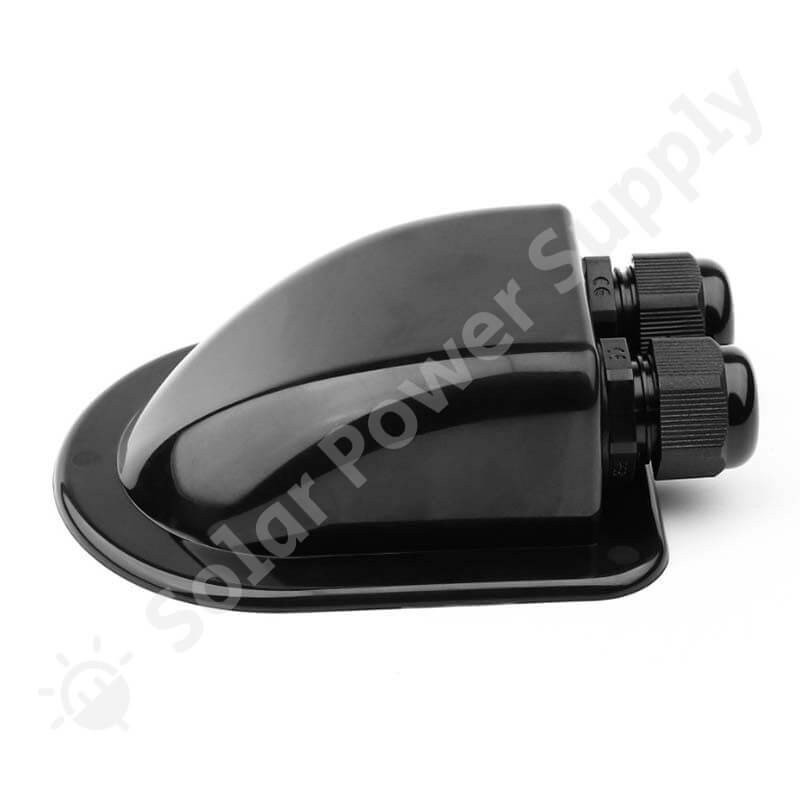

A black part for dark roofs
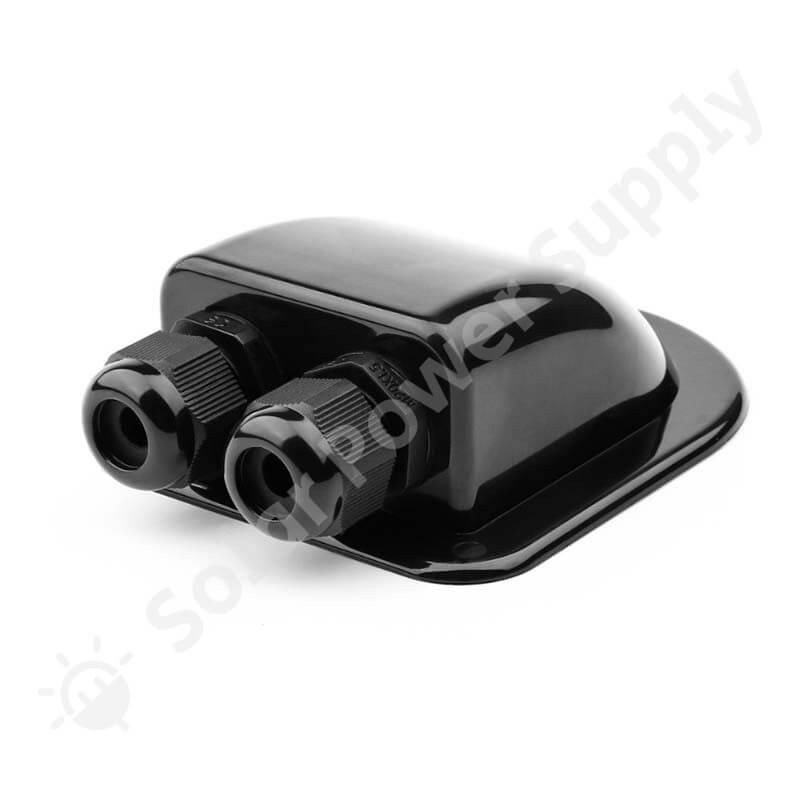
Photovoltaic panels are often laid on slate, anthracite or bituminous roofing. To keep the cable crossing discreet, this pass-through housing comes in black. It has two entries, enough to bring two conductors down together rather than multiplying openings in the building envelope. It is a link between outside and inside, with no electronics or moving part.
Read the listing before drilling
The information available is limited to material, colour and dimensions. The accepted cable diameter, the fixing system and the level of sealing are not specified: do not assume them. Refer to the manufacturer’s documentation, or ask a roofer, before you decide to drill.
Situations where it helps
- A pitched roof covered in slate or dark steel sheet.
- A black or dark grey converted van with a flexible panel on the roof.
- A garden shed or carport fitted with a few modules and an indoor box.
- A tradesperson’s small installation that aims to limit the number of crossings.
Material and measurements
The housing is made of ABS plastic. This material is light, does not rust and is easy to handle on a roof. Its dimensions, 13 x 9.5 x 4 cm, tell you whether the planned location is big enough: allow a clear space a little wider than the object itself so you can work comfortably.
Listing data
- Type: double solar cable gland
- Material: plastic (ABS)
- Dimensions: 13 x 9.5 x 4 cm
- Colour: black
- Manufacturer warranty: 2 years
Suggested fitting steps
- Pick a flat spot as close to the modules as possible.
- Check that the cables, connectors included, go through the entries.
- Mark and drill, taking the roof structure into account.
- Fit the part following the instructions and treat the joint with a product suited to your covering.
- Inspect the result visually after the first rain.
If you are unsure of the cable route, sketch the roof with the position of the modules, the housing and the entry into the building: this avoids finding out too late that a cable is too short or crosses a walkway. Always leave a little slack to absorb expansion and the movement of the wind.
Safety
Working on a roof carries a risk of falling: use a harness or hand the task to a professional. As long as the modules receive light, their cables are live; do not cut or strip them without disconnecting the circuit. For any link to the dwelling’s distribution board, call a qualified installer.
Maintenance
Once a year, climb up safely or use binoculars to examine the housing: it should show no crack, no play and no sign of seepage around it. Leaves and moss that collect there can be removed by hand or with a soft brush. Replace the part if the plastic is damaged.