

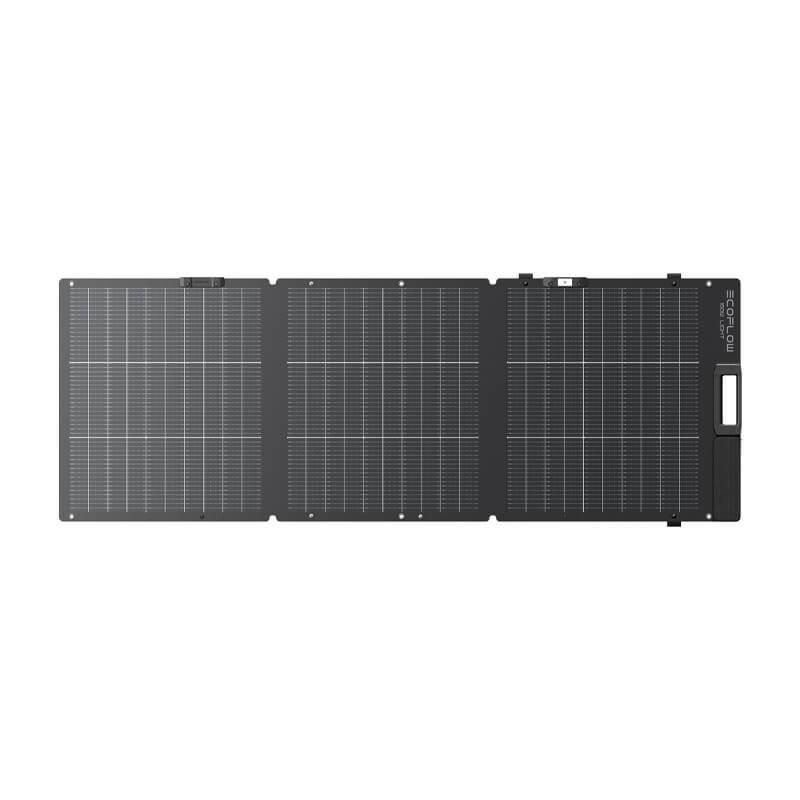


What does this 160 W panel do?
It turns daylight into direct current to recharge a power station or a battery whose solar input uses an XT60 connector. Its thick-tablet shape when folded and its 3.8 kg weight make it a companion for outings where every kilo counts: a canoe escape, a weekend in a tent, a stay in a tiny house.
How to use it day to day
Take it out of its folded position, spread it facing the sun, then link its XT60 output to the device. It is better to start with the panel open and in full sun, then plug the cable, and watch the battery’s display to confirm that the energy input is registered. If the displayed value is low, change the orientation or remove shadows.
Setting the heading
In the northern hemisphere, turn it towards the south and tilt it so the rays arrive roughly perpendicular. A simple piece of wood or a bag under the upper edge is enough to prop it.
Intended audiences
- Motorhome and van travellers who supplement a roof that is already equipped.
- Anglers, photographers and self-reliant hikers.
- Small technical teams working in remote areas with low-demand tools.
Construction
The cells are TOPCon type in monocrystalline silicon. Thickness stays at 26 mm when opened out, and the weather protection is stated as IP68, a high level that reassures against dust and splashes; still, reread the manufacturer’s immersion guidance before testing its limit. The panel measures 609 × 598 × 26 mm folded and 1677 × 598 × 26 mm unfolded.
Strengths drawn from the data sheet
- 160 W for 3.8 kg: a power-to-weight ratio that favours travel.
- An XT60-type output for direct pairing with stations that have this connector.
- An elongated unfolded surface, easy to lay on a tent roof or a beach.
Electrical and physical values
- Power: 160 W
- Open-circuit voltage (Voc): 21.4 V
- Voltage at maximum power (Vmp): 18.8 V
- Current at maximum power (Imp): 8.7 A
- Short-circuit current (Isc): 9.2 A
- Technology: TOPCon, monocrystalline silicon
- Connector: XT60
- Rating: IP68
- Weight: 3.8 kg
Precautions
Check that the values above are compatible with your device’s input before plugging in. Do not use a damaged cable, do not bend the panel in an unusual direction and do not lay it on a very hot surface. For any integration into a fixed installation, call on a qualified professional. When several devices share the same solar input, do not assume they can all be fed at once: consult the manual of your equipment about the limits it accepts, and never leave a charging battery in direct sun inside a closed vehicle.
After the outing
Sponge off sand or mud with a damp cloth, let it dry in the shade, then fold it. Store it flat in a mild, ventilated place.


