Why activate a surface before bonding?
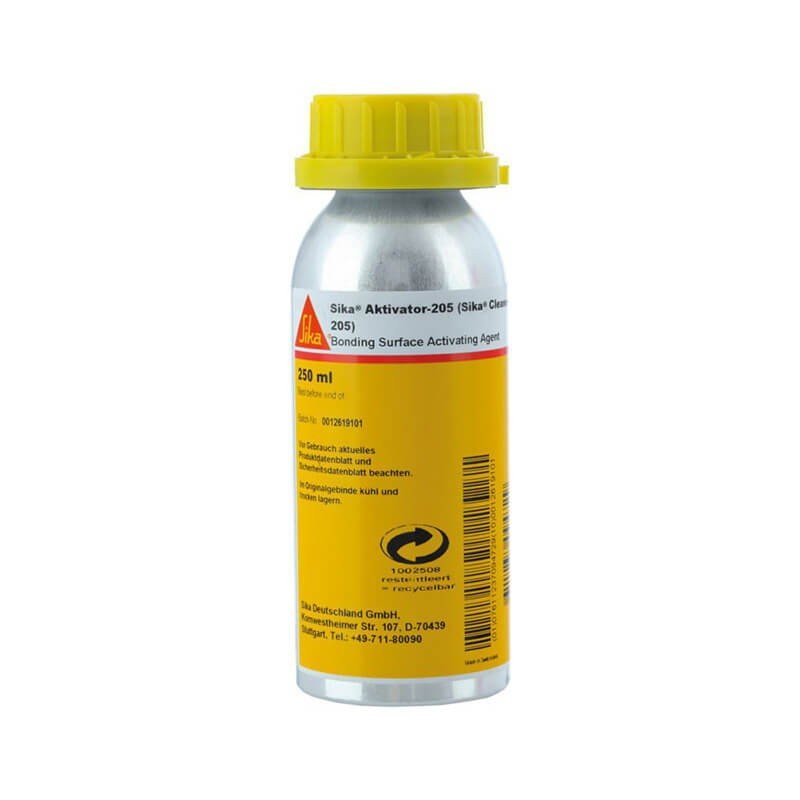
On a smooth or unreceptive substrate, adhesive or sealant can struggle to grip. That is the job of an activator: it prepares the surface so the joint that follows bonds better with the material. Sika Aktivator 205 is made for this preparation step and comes in a 250 ml bottle, an amount that is easy to dose for modest jobs.
Principle of use
You start by cleaning the substrate and letting cleaning residues evaporate, then wipe the activator over the area to be treated, usually with a clean, lint-free cloth. The evaporation time before the adhesive goes on, the compatibility with each material and the number of passes are defined by the manufacturer. Check its data sheet before working; they are not detailed here because the information supplied is limited.
Where and by whom it is used
A private user fitting out a van or redoing the seal of an accessory on a boat will find a way to improve how an assembly holds. A fitting professional, a body shop or a maintenance team will add it to their preparation range.
- Preparing parts before bonding an accessory.
- Reworking a joint on an already treated substrate.
- Workshop jobs where a repeatable process matters.
What is known about the product
The available information is limited to the Sika brand, the name Aktivator 205 and the 250 ml volume. No composition, list of compatible materials or drying time is stated here. This caution avoids false expectations: always check compatibility with your substrate and with the adhesive you plan to use.
Advantages
- A brand specialised in bonding and sealing.
- A 250 ml volume that suits small quantities.
- Fits into a preparation chain before adhesive or sealant.
Technical specifications
- Brand: Sika
- Name: Aktivator 205
- Content: 250 ml
Setting up the job
Plan for a clean, well-lit work surface. Mask areas that must not be treated, apply the activator only to the bonding perimeter, then carry on without delay as soon as the manufacturer allows it: an activated surface left open to the air for too long can lose its benefit. For a fixing that carries a load or a safety-related part, ask a professional for advice.
Safety precautions
- Work in a ventilated space and away from any flame.
- Wear suitable gloves and eye protection.
- Avoid contact with skin and eyes; follow the label instructions.
- Keep the product out of children’s reach.
Storage and care of equipment
Close the bottle firmly after use and keep it upright in a cool, dry place out of direct sunlight. Use a clean cloth for each application and dispose of used ones under local rules. If the bottle is old or has been open for a long time, reread the manufacturer’s storage guidance before reusing it.